
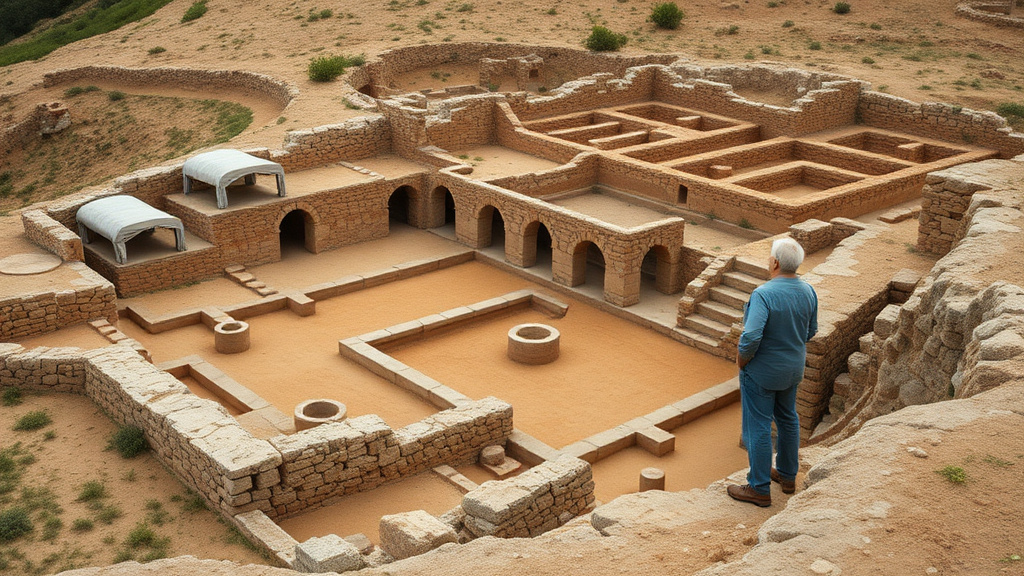
Transformative discoveries are redefining our understanding of Roman civilization. Using advanced ground penetrating radar technology, archaeologists have uncovered a strikingly intact Roman settlement hidden beneath sediment layers for nearly two millennia. This innovative method allows researchers to investigate below the surface without invasive excavation, revealing detailed insights of structures, artifacts, and everyday activities. Explore how this technological innovation is revolutionizing the field and what these extraordinary results reveal about Roman civilization.
Revolutionary Detection Approaches
GPR technology marks a fundamental change in archaeological exploration. This non-invasive imaging technique employs electromagnetic waves to locate subsurface features without disturbing the soil. By examining how these waves reflect off buried structures and artifacts, researchers can generate detailed maps of buried arrangements. This method proved invaluable at the Roman site, where GPR located structural foundations, roads, and pottery concentrations with remarkable precision, allowing archaeologists to design strategic excavations methodically.
The strengths of GPR technology go further than mere convenience. Traditional excavation methods risk destroying delicate artifacts and irreplaceable archaeological contexts. GPR surveys protect contextual integrity while providing comprehensive data about spatial relationships and settlement organization. Furthermore, this technology hastens identification significantly, enabling archaeologists to cover vast areas efficiently. The Roman settlement’s successful identification demonstrates how modern technological innovation strengthens our capability to unlock ancient secrets while respecting the sanctity of historical sites for ongoing study and posterity.
The Roman Colonial Findings
The excavation brought to light a comprehensive Roman settlement from the 2nd century CE, complete with residential structures, public buildings, and commercial establishments. The site encompasses approximately three hectares and demonstrates sophisticated city design typical of provincial Roman towns. Ground penetrating radar detected numerous subsurface features, such as foundations, roads, and underground storage facilities. The settlement’s layout indicates a flourishing settlement with distinct residential and commercial zones, providing invaluable insights into Roman provincial life and architectural practices in this era of prosperity.
Structural Remains and Archaeological Objects
Archaeologists uncovered exceptionally intact stone foundations comprising approximately fifteen dwelling units, together with what seems to be a modest public square and administrative building. The structures display characteristic Roman construction techniques, including opus caementicium concrete and carefully arranged stone blocks. Numerous artifacts unearthed at the site encompass pottery fragments, coins, implements, and decorative items that shed light on everyday life and trade connections. These findings point to the community sustained strong trade connections extending throughout the Roman Empire, promoting exchange of goods and ideas across vast distances.
The artifact assemblage offers strong indicators of class divisions within the community, with luxury items suggesting wealthy inhabitants alongside practical everyday items associated with poorer inhabitants. Foreign pottery from Mediterranean regions reveal the settlement’s integration into broader Roman trade networks. Personal items such as ornaments, hair accessories, and writing tools provide insight into personal existence and household activities. The diversity and quantity of artifacts recovered highlight the settlement’s significance as a regional economic hub sustaining diverse populations and trading businesses.
Chronology and Historical Importance
Multiple chronological methods, such as radiocarbon analysis and ceramic typology, verify the settlement thrived during the second and third centuries CE, a period of considerable Roman expansion in the region. This temporal sequence positions the site within a critical era of territorial expansion and material wealth. The settlement’s creation coincides with substantial Roman construction initiatives and military campaigns that strengthened control over peripheral areas. Comprehending this historical timeframe helps archaeologists reconstruct territorial historical records and recognize how indigenous populations adjusted to Roman imperial rule and profited from integration into the wider empire.
The finding holds substantial historical significance for scholars examining Roman provincial settlements and patterns of urbanization. This site offers uncommon archaeological findings of how Romans founded and sustained communities in outlying areas, adapting their systems of architecture and administration to regional circumstances. The settlement’s apparent prosperity and longevity suggest effective assimilation with surrounding populations and efficient management of resources. These findings add significantly to broader discussions about Roman imperial expansion, spread of culture, and the mechanisms through which Rome preserved its vast territorial dominion across centuries.
GPR Technology
Ground Penetrating Radar, commonly known as GPR, represents a revolutionary advancement in archaeological research. This non-invasive technology utilizes radio frequency signals to create comprehensive underground imagery without disturbing the soil. By transmitting radio waves into the ground and analyzing their reflections, archaeologists can detect underground formations, archaeological remains, and subsurface characteristics with exceptional accuracy. The technology has proven invaluable in uncovering the Roman settlement, allowing researchers to map structural bases, pathways, and storage facilities before any excavation begins.
The strengths of GPR technology extend far beyond simple detection capabilities. This method substantially lowers excavation costs while protecting archaeological contexts that traditional digging might damage or destroy. The detailed 3D mapping data generated by GPR enable archaeologists to develop targeted excavation strategies, focusing efforts on the most likely locations. Furthermore, the technology offers thorough insight of entire settlements, exposing layout connections and urban planning patterns that would otherwise lie buried beneath centuries of built-up earth and materials.
- Electromagnetic waves pass through soil layers identifying buried structures
- Non-invasive method preserves site integrity and integrity
- Creates detailed three-dimensional subsurface imaging data
- Reduces digging expenses and duration significantly
- Enables focused investigation strategies for maximum efficiency
